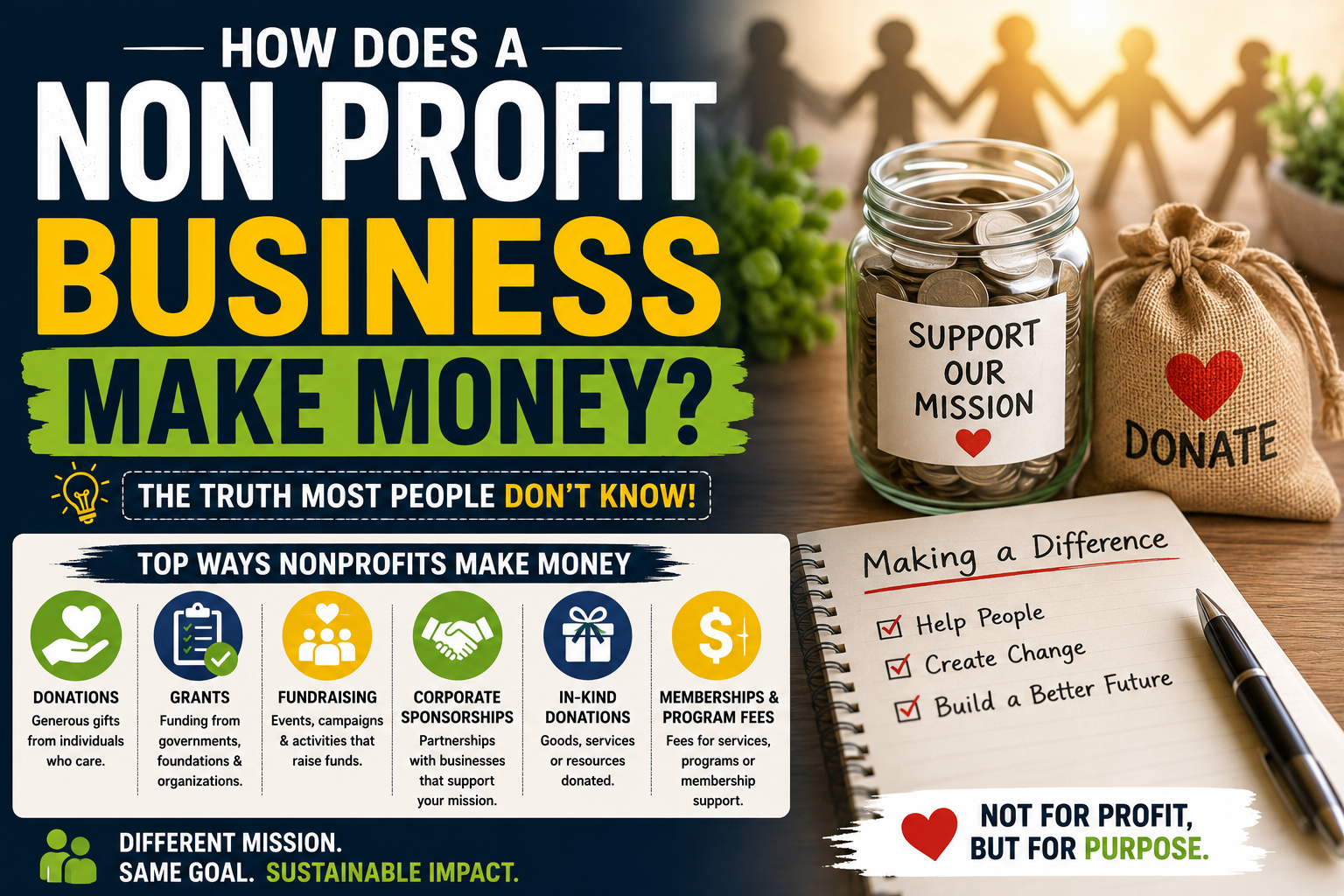
10 Powerful Facts: How Does a Non Profit Business Make Money?
What is the income of a non profit business? “But doesn’t the word ‘nonprofit’ mean that they don’t make any money?” is a question that countless people ask because the word ‘nonprofit’ gives the wrong idea that they don’t make money. But in fact, the nonprofit sector can make millions of dollars annually. The distinction is not between making money or not; it is how they spend money. Nonprofits use the profits for programs, services, staff, and community efforts to fulfill their mission rather than distributing profits to owners or shareholders.
It is important to understand the revenue generation of nonprofits because it explains why many nonprofits continue to thrive, such as charities, educational institutions, hospitals and community organizations, and serve the public.
After which comes the money, where does it come from?
Suppose there is an organization that is a non-profit that opens its doors Monday morning.
Staff report for work, volunteers get ready for community activities and programs start serving people. This is all done without funding.
So what is the source of the money?
Let’s head for the various sources of revenue that sustain non-profit organizations.
Revenue Source 1: Individual Donations
Individuals are the primary source of funds for many nonprofits.
The reason supporters give is because they agree with the organization’s overall mission. Donations can be made:
- Online
- By mail
- At fundraising events
- By giving monthly via monthly giving programs
- As one-time contributions
Many small donations can make for a consistent cash flow.
Revenue Source 2: Grants
Many non-profits are funded by grants from:
- Government agencies
- Private foundations
- Community organizations
- Corporate giving programs
Grants are typically given for particular projects or services and are not donations.
Applications may be comprehensive, and organizations will often describe in detail how the funds will be spent and what success looks like.
Revenue Source 3: Fundraising Events
Fundraisers are an effective way for nonprofits to raise funds and draw attention to their mission.
Common events include:
- Charity walks
- Auctions
- Gala dinners
- Community festivals
- Sports tournaments
- Benefit concerts
In addition to revenue-generating, these are events that can bring new supporters and volunteers.
Revenue Source 4: Membership Fees
A few non-profit organizations offer membership programs.
Members can benefit from:
- Newsletters
- Educational resources
- Event discounts
- Networking opportunities
- Exclusive content
Membership fees guarantee steady income all year round.
Revenue Source 5: Selling Products or Services
As a nonprofit entity, a school can sell products or services.
Examples include:
- Museum gift shops
- Educational courses
- Training programs
- Books
- Branded merchandise
- Ticket sales
As long as they support the nonprofit’s work, they are not prohibited by law and they may be an important source of revenue.
Revenue Source 6: Corporate Sponsorships
Many businesses enter into a sponsorship agreement with a nonprofit entity.
A company may provide:
- Financial support
- Equipment
- Services
- Event sponsorship
- Employee volunteer programs
The relationships help the nonprofit as well as the sponsoring company in the following ways: by supporting community efforts and in enhancing the corporate social responsibility.
Revenue Source 8: Interest on Loans, Real Property, and other Investments
Already, there are some nonprofits with investment portfolios or endowment funds.
Earning from investments can be from:
- Stocks
- Bonds
- Mutual funds
- Savings accounts
- Other financial investments
These returns will help sustain future projects and operations.
Revenue Source 8: Government Contracts
Some NGOs provide services for government agencies.
Examples include:
- Healthcare programs
- Housing assistance
- Workforce development
- Childcare services
- Community support programs
The government pays money for the delivery of public services, called a government contract.
A revenue source is any source of anticipated income.
Revenue Source 9: Planned Giving and Bequests
A large number of supporters elect to incorporate nonprofit companies in their estate plans.
These intentional gifts can be:
- Cash
- Property
- Investments
- Life insurance benefits
- Retirement assets
Although unpredictable, legacy gifts can provide significant financial support.
Revenue Source 10: Online Fundraising Campaigns
Digital fundraising is becoming more and more significant.
These are just some of the ways that many nonprofits have begun to raise funds:
- Crowdfunding platforms
- Email campaigns
- Social media fundraising
- Peer-to-peer fundraising
- Recurring online donations
Organizations have the ability to connect with supporters globally using technology.
What Happens to the Money?
The one of the biggest differences between nonprofits and businesses is the use of revenue.
Nonprofit organizations typically allocate any excess profit or other assets to one of the following:
- Community programs
- Employee salaries
- Volunteer support
- Equipment
- Facilities
- Educational materials
- Future projects
- Emergency reserves
This permits the organization to keep on its mission and expanding impact on the world.
Can a Nonprofit Make a Profit?
Yes.
Nonprofits can earn above their expenses in a year (although the word “profit” is not used in their names).
This extra financial resources is generally referred to as a surplus instead of a profit.
The key is that the extra is saved toward the organization instead of bestowed on people.
Nonprofits with financial reserves will also have a more stable financial foundation during tough economic times.
Common Misconceptions About Nonprofits
A lot of people are mistaken about the operation of nonprofit organizations.
Myth: Nonprofits can’t make money.
Reality: They have a number of ways to monetize it.
Myth: Workers work for free
Reality: There are full-time professionals working at many nonprofits who earn competitive salaries.
Myth: All Donations are spent directly on Programs
Truth: There are costs associated with: Administration, staff wages, technology and facilities needed to operate effectively.
Myth: Nonprofits Never Pay Taxes
Truth: Tax regulations are different for every organization, income source and jurisdiction.
Why Diversification of Income is important?Why it is important to diversify income?
Why Diversifying Income Matters?
A successful nonprofit will have several sources of revenue such as donations, grants, sponsorships, memberships and earned income.
When an organisation has diversified, it maintains its financial security despite a reduction in one funding stream.
Final Thoughts
Knowing the answer to how does a non profit business make money can help you remove one of the most often misunderstood aspects of charitable organizations. Nonprofits can generate revenue from donations, grants, fundraisings, membership, selling products, sponsorships, investments and a variety of other sources. The main difference is that any profits are used to further the mission of the organization rather than shared with owners or shareholders.
These tips can help nonprofit organizations keep making a difference, increasing their program offerings and serving communities in the future by managing its finances responsibly and diversifying revenue sources.
FAQS
How does a non profit business make money?
Nonprofits make money in a variety of ways, including membership fees, product sales, government contracts, online fundraising, investments, fundraising events, and donations.
Is there a way to make money for a nonprofit?
Yes. While a nonprofit may make more money than it expends, most surpluses will need to be used to further its mission, not distributed to its owners or shareholders.
Is there salary paid to nonprofit employees?
Yes. Full-time and part-time employees are hired by many nonprofit organizations to work for a monetary compensation, which may include administrators, managers, educators, healthcare professionals, and other professionals.
Which is the largest revenue for most nonprofits?
While grants, government contracts and fundraising events are also important sources of income for many nonprofits, individual donations are the biggest revenue stream.
Is it possible to sell product or services in nonprofit organizations?
Yes. A variety of nonprofits sell merchandise, education, event tickets, books, or other products/services as long as the sales are related to their charitable efforts and do not violate any applicable laws.