How to Budget Money on a Low Income
I want to start this by saying something most budgeting articles won’t: if you’ve read “just cut your lattes” advice and thought that’s not going to fix anything, you’re right. I’ve been in a stretch where my paycheck covered rent, utilities, and gas to get to work, and pretty much nothing else. In that situation, there is no latte to cut. There’s no discretionary spending hiding in the couch cushions. The math just doesn’t work no matter how disciplined you are, and pretending otherwise isn’t helpful — it’s actually a little insulting.
So this isn’t going to be that kind of article. This is how to budget money on a low income when necessities are already eating most or all of your paycheck, written by someone who’s lived it and figured out what actually helped versus what was just noise. If you’re looking for how to budget money on low income for beginners, or you want a low income calculator-style approach, or you’re trying to figure out how to budget and save money on a low income when saving feels almost impossible — this covers all of it, honestly and without judgment.
Why Generic Budgeting Advice Often Doesn’t Work Here
Standard budgeting rules like the 50/30/20 rule assume you have some slack — that 50% ceiling on “needs” just doesn’t hold up when your rent, utilities, and groceries alone eat more than half your income before anything else even gets considered. That rule was built around a moderate-income baseline, and treating it as a universal target sets a lot of people up to feel like they’re failing at math that was never designed for their situation in the first place.
There’s a concept that gets talked about a lot in communities like r/povertyfinance that I think explains this better than anything else: it’s expensive to be poor. It sounds almost like a cliché until you’ve lived it. You can’t buy in bulk to save per-unit cost because you don’t have the cash on hand for the bigger purchase. Banking costs more if you’re carrying a low balance, because overdraft fees and minimum balance requirements hit harder the less cushion you have. Without an emergency cushion, a car repair or medical bill can push you toward a payday loan or a high-interest credit card, and now you’re paying interest on top of an expense you couldn’t avoid in the first place. Even preventive stuff — routine car maintenance, needed dental work — gets skipped because the upfront cash isn’t there, even though skipping it usually costs more down the road. It’s a real, structural trap, not a personal failing, and I think any honest article on this topic needs to say that plainly before getting into tactics.
And I want to say one more thing before we get into the practical stuff: if you’re exhausted by the constant background stress of triage decisions — which bill, which grocery item, which shift to pick up — that exhaustion is real and it’s not a character flaw. Budgeting on a low income is emotionally taxing in a way that budgeting advice rarely acknowledges. Be kind to yourself through this.
The Triage Framework: What to Pay First When You Can’t Pay Everything
This is the single most useful thing I learned, and it’s honestly the part most budgeting content skips entirely. When your income doesn’t stretch to cover everything, the answer isn’t to pay bills in the order they’re due — it’s to prioritize by the consequence of not paying them.
Shelter comes first. Losing housing has the most severe, compounding consequences of anything on this list, so rent or mortgage gets protected above almost everything else. Right behind it are the utilities that keep your home habitable — electricity, heat or gas, and water — especially in extreme weather, since many regions actually have legal protections against shutoff during dangerous temperatures, which is worth researching locally through your state or utility company directly.
After that comes food, including maximizing every food assistance benefit you’re eligible for (more on that below). Then essential transportation — if you need a car or a transit pass to get to the job that’s producing your income, that’s not a discretionary cost, that’s protecting your income source itself. Right alongside that: minimum payments on any debt tied to something essential, like a car loan on the vehicle you need for work, for the exact same reason.
Everything else — credit cards, medical bills, personal loans — comes after. I know that feels uncomfortable, because those creditors call and the pressure is real. But the consequences of falling behind there, while serious, are generally less immediately catastrophic than losing your housing, your utilities, or your ability to get to work. This ranking isn’t about ignoring debt; it’s about surviving the acute crunch without losing something you can’t easily get back.
Talk to Your Creditors Before You Miss a Payment, Not After
This one surprised me the first time I actually tried it. I called my utility company before a bill was due, explained I was going to be short, and asked if there was a hardship program. There was. I hadn’t known to ask, and it turns out a lot of companies have formal payment plans or temporary deferment options that go completely unused simply because customers don’t think to ask for them. Creditors also tend to respond far better to a proactive call than to silence followed by a missed payment — it changes the whole tone of the conversation.
Please Avoid Payday Loans and High-Cost “Solutions”
I need to be direct here: payday loans, auto title loans, rent-to-own arrangements, and cash-advance apps with high fees turn a temporary shortfall into a much worse, compounding problem. I understand why they feel like the only option in the moment — sometimes they genuinely are the only door that seems open. But if there’s any alternative available, take it. Local nonprofit emergency assistance programs, community action agencies, religious or charitable organizations, and even asking family or your community network are lower-cost or no-cost alternatives worth trying first. I’ll be honest that these resources aren’t guaranteed to be available or enough for everyone — but they’re worth checking before a high-interest loan, every time.
How to Budget Money on Low Income for Beginners
If you’re just getting started with this, here’s the practical, step-by-step version I’d walk a friend through.
Zero-Based Budgeting Still Matters Here — For a Different Reason
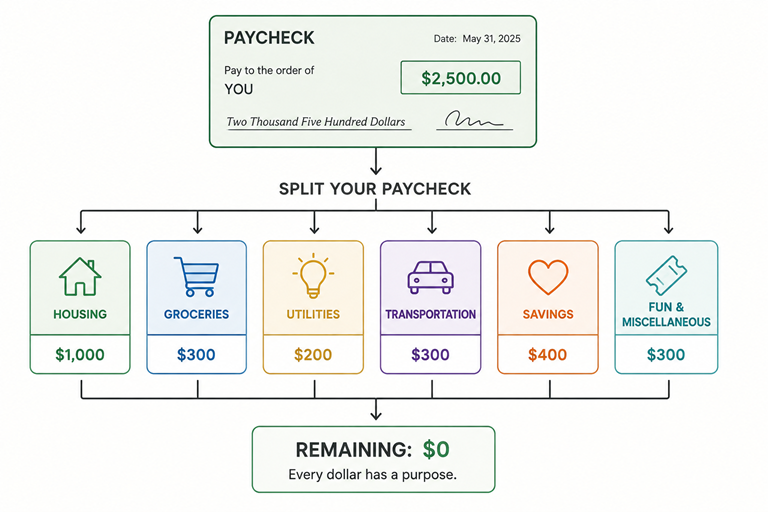
I know zero-based budgeting usually gets pitched as a way to optimize where your “extra” money goes. On a low income, there often isn’t extra money — but that’s exactly why this method still matters, maybe even more than it does for higher earners. When there’s zero slack in your budget, knowing with total certainty where every single dollar needs to go is the only real way to avoid an accidental shortfall. I’ve written more on how this method works in general here: loonnews.com/why-zero-based-budgeting-is-the-best-method — the core idea applies just as much here, just with tighter margins.
If Your Income Is Irregular, Budget by Priority Instead of by Average
A lot of low-income households also deal with irregular income — inconsistent hours, seasonal work, multiple part-time jobs, gig work stacked together. If that’s you, don’t build your budget around an average month. Instead, fill your categories in strict priority order as the money actually arrives, using the triage list above as your guide. That way, if a paycheck comes in lower than expected, whatever does arrive automatically goes toward the highest-consequence categories first, instead of getting spread thin across everything.
A related technique that helped me a lot: build your baseline budget around your lowest realistically expected income month, not an average one. That way a bad month doesn’t automatically create a shortfall — and if a better month comes along, that extra becomes a bonus for savings or debt payoff, not something that quietly becomes your new normal spending level.
Cash Envelopes Can Genuinely Help Here
Physical cash envelopes get recommended a lot more seriously in this specific situation than in general budgeting content, and for good reason. Using cash avoids overdraft fees entirely, which matters a lot when you’re working with a low account balance. And there’s something to the hard physical limit of an empty envelope that a digital balance — which can just slide into overdraft — doesn’t replicate.
Cutting Costs That Actually Move the Needle
I’m going to skip the “make coffee at home” advice, because if you’re reading this, you probably already know that one. Here’s what actually made a measurable difference for me.
Housing is usually your biggest expense, so it’s the highest-leverage place to look — a roommate or house-share, negotiating rent at renewal time, or researching subsidized or income-based housing programs in your area, if that’s an option worth exploring for your situation.
Food goes beyond “cook at home.” Plan your meals around what’s actually on sale that week rather than a fixed meal plan — store flyers and apps make this easy. Buy store-brand or generic products for staples; the savings add up with almost no noticeable difference in quality. Batch cook and freeze portions, which cuts cost-per-meal and removes the temptation to grab costlier convenience food on a busy night. And please use food banks and pantries without any shame attached — they exist specifically for situations like this one, not as a last resort for “other people.” I used one for a few months and it genuinely helped me stay afloat; there’s nothing to be embarrassed about there.
Transportation is worth a hard, honest look at true cost — payment, insurance, fuel, and maintenance combined — compared against public transit, biking, or carpooling if any of those are genuinely feasible for your situation. Keeping up with reliable maintenance on a used car, even when it’s tempting to skip it, avoids the “poverty is expensive” trap of repeated costly emergency repairs down the line. Also check whether your local transit system offers reduced-fare or income-based programs — a lot of them do, and a lot of eligible riders never apply simply because they don’t know it exists.
Banking fees are a category general budgeting content barely mentions, but they matter a lot here. Look specifically for fee-free checking accounts, including accounts designed for lower-balance customers — some banks are required to offer these in certain regions. Set up low-balance alerts, or consider opting out of overdraft “protection” altogether, since it often functions more like an expensive loan than an actual safety net. And if you have access to a credit union, it’s worth checking — they’re frequently cited as offering lower fees and more flexible terms than large traditional banks.
Utilities are worth stabilizing through equal or budget billing, which converts an unpredictable seasonal spike into a flat monthly amount — I’ve written a full breakdown of how that works here: loonnews.com/what-is-equal-billing-monthly-budget. It’s especially valuable when you don’t have much buffer for a surprise peak-season bill. Also look into utility assistance programs — many utility companies run their own hardship funds separate from government programs, and again, these go underused mostly because people don’t know they exist.
How to Budget and Save Money on a Low Income (Yes, It’s Possible)
I know saving anything can feel almost like a joke when you’re stretched this thin. Here’s the reframe that made it click for me: forget the standard advice about a 3–6 month emergency fund. That target is genuinely discouraging as a starting point, and honestly, it should be treated as a much later milestone, not a first one.
Instead, aim for a much smaller first goal — something sized to cover a single common small emergency, like a car repair, a utility deposit, or a missed shift’s worth of income. Think a few hundred dollars, not a few thousand. The point isn’t to build wealth yet. The point is to have just enough that you don’t have to reach for a payday loan or overdraft the next time something small goes wrong. That reframe — buffer as debt-cycle prevention, not buffer as long-term wealth building — made the goal feel achievable instead of impossible.
Automate tiny, consistent amounts if you can — even $5 or $10 per paycheck. Don’t wait for “extra” money that might never reliably show up. Small, automated, and consistent beats waiting for a windfall that may not come. And speaking of windfalls — tax refunds (especially if you qualify for refundable low-income tax credits), one-time benefit payments, or unexpected small windfalls matter disproportionately at this income level. If you get one, consider directing a high percentage of it straight into that buffer, since organic monthly savings capacity is often minimal here.
Here’s the bigger picture worth remembering: building even a small buffer isn’t really “saving” in the traditional sense. It’s breaking a cycle. Without any cushion, every small emergency turns into new high-interest debt, which makes next month’s budget even tighter, which makes the next emergency even more likely to turn into debt too. A small buffer interrupts that loop before it compounds.
Assistance Programs: A Core Budgeting Strategy, Not a Last Resort
I used to think applying for assistance meant I’d failed at budgeting. I was wrong, and I wish someone had told me that sooner. The honest truth, backed up by a lot of discussion in this space, is that a huge share of people who qualify for assistance programs never apply — usually because they don’t know the program exists, they feel embarrassed, or they assume incorrectly that they won’t qualify. Checking your eligibility for every program you might be entitled to is genuinely a core budgeting action. It’s not separate from budgeting, and it’s not shameful — it’s closer to finding money that’s already legally available to you.
A few categories worth checking, though exact names and eligibility vary a lot by country, state, and even county, so verify locally: food assistance programs (like SNAP in the U.S., or your country’s equivalent, plus WIC-style programs if you’re pregnant or have young children), utility assistance programs (like LIHEAP in the U.S., or your utility’s own hardship fund), housing assistance (subsidized housing, housing voucher programs, emergency rental assistance), healthcare assistance (income-based public insurance, sliding-scale community clinics, or hospital financial assistance policies many patients don’t realize they can apply for even after a bill has already arrived), tax credits for low-to-moderate income workers (often one of the biggest single windfalls available in a given year), and childcare assistance, since childcare cost alone can make working financially unfeasible for some parents without help.
A good starting point in the U.S. is dialing 211, a free social services referral hotline that can screen you for multiple programs at once instead of researching each one separately — most regions have some equivalent service. Your state or local Department of Health and Human Services website and community action agencies are also solid entry points. For general guidance on this, the Administration for Children and Families’ benefits resources is a reliable place to start.
I want to say this one more time, plainly: applying for these programs is not a personal failure. It’s a safety net you’ve likely already paid into through taxes, and using it is a legitimate, smart budgeting strategy — not something to feel ashamed of.
Increasing Income: Often the Most Necessary Step
Here’s something I think needs to be said clearly: expense-cutting has a floor. You can’t go below zero. Once you’ve triaged your bills, cut what can genuinely be cut, and checked every assistance program you might qualify for, and there’s still a gap — income growth often isn’t optional advice anymore. It’s frequently the only lever left.
A few realistic options worth exploring: requesting more hours at your current job, or looking for a second part-time job with a schedule that genuinely works alongside your first. Skills-based freelance or gig work matched to something you’re already good at tends to pay better than generic gig-app work once you factor in gas and vehicle wear. Free or low-cost skills training and certification programs — often available through community colleges or local workforce development boards — can open the door to higher-paying roles without the cost of a full traditional degree. Selling unused items around your home can generate a fast, one-time cash injection when you need it. And it’s worth checking whether your employer offers benefits you’re not using — a flexible spending account, tuition assistance, or an employee assistance program that includes free counseling or financial coaching are often sitting there unused.
A Simple Low Income Budget Calculator Approach
You don’t need a fancy paid app for this — honestly, for this specific situation, I’d actively avoid adding a subscription cost to an already tight budget. A simple spreadsheet works fine, and free tiers of mainstream budgeting apps (I’ve compared several here: loonnews.com/best-budgeting-apps-for-couples) are a solid no-cost option too.
For a genuinely simple low income budget calculator approach, list your total income for the period, then list your essential expenses in triage order — shelter, utilities, food, transportation, secured debt — and see immediately where the gap is, if there is one. That gap is exactly what assistance programs and income growth are meant to help close; it’s not a sign you’ve done something wrong with the math.
If you’d rather talk to a person than fill in a spreadsheet, nonprofit credit counseling agencies (look for ones that are accredited and not-for-profit) often offer free budgeting counseling specifically for this situation, and a counselor there can also help identify assistance programs you might not have thought to check. The National Foundation for Credit Counseling is a good place to start looking for an accredited option.
Common Mistakes Worth Avoiding
A few patterns come up again and again in this space, and I’ve made more than one of them myself. Applying generic percentage-based rules that don’t reflect your actual situation just leads to discouragement when the numbers don’t work — they were never built for this. Skipping assistance programs out of stigma or assumed ineligibility leaves real, available money on the table. Reaching for payday loans or high-interest cash advances to cover a shortfall compounds the original problem instead of solving it. Setting the standard 3–6 month emergency fund as your first goal, instead of a smaller achievable milestone, often leads to giving up entirely. Overlooking banking fees as a real budget category is easy to do, but overdraft and low-balance fees can be a genuinely disproportionate drain. And neglecting the income side of the equation, treating budgeting as purely about cutting, misses the fact that income growth is often the more decisive lever once cutting hits its floor.
You’re Not Doing This Wrong
If there’s one thing I want you to walk away with, it’s this: if the math isn’t working, that’s not a personal failure, and it’s not something more discipline alone can fix. Triage your bills by consequence, not by due date. Check every assistance program you might qualify for — that’s a budgeting strategy, not a last resort. Build a small buffer sized to prevent a debt cycle, not a full emergency fund right away. And don’t treat income growth as optional once expense-cutting hits its ceiling, because for a lot of us, it genuinely is the missing piece. You’re not failing at budgeting. You’re doing math under conditions the math was never designed for — and that’s a very different thing.