What Is Equal Billing and How Can It Help You When Creating Your Monthly Budget?
I still remember the winter my electric bill jumped from $95 to $310 in a single month. I hadn’t done anything differently — it was just a brutally cold February, and my heater was working overtime. That one bill wrecked an otherwise perfectly good budget I’d spent weeks building, and I had to pull money from my “fun” category and part of my grocery money just to cover it.
That’s the month I finally called my utility company and asked about something a coworker had mentioned offhand: equal billing. Honestly, I wish I’d known about it years earlier, because it solved a problem I didn’t even realize was solvable — the fact that my “fixed” utility bill was actually one of the most unpredictable line items in my whole budget.
So let’s talk about what equal billing actually is, how it helped me (and can help you) when creating a monthly budget, and then I’ll walk you through building a full monthly budget from scratch, including a simple template structure you can copy today.
What Is Equal Billing, Exactly?
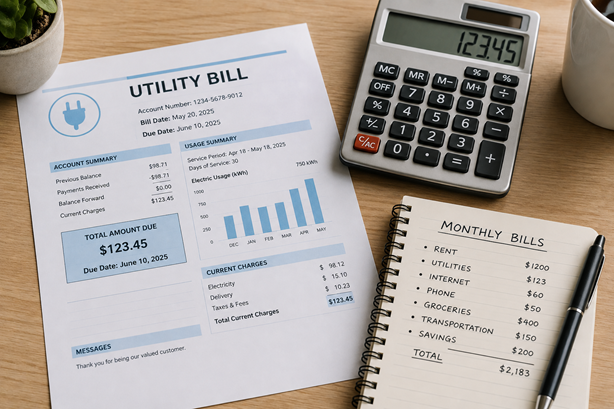
Equal billing is a program offered by utility companies — most often for electric and gas, sometimes water too — that takes your estimated annual usage cost and spreads it evenly across all 12 months, instead of billing you the actual, fluctuating amount you used each month. So instead of paying $60 in a mild April and $280 in a brutal August, you’d pay something like $140 every single month, based on a projection of your yearly usage smoothed out evenly.
Different utility companies call this by different names, which honestly confused me the first time I went looking for it — I searched “equal billing” on my provider’s site and found nothing, because they called it “budget billing” instead. You might also see it labeled levelized billing, average billing, an average payment plan, or an equal payment plan (EPP). If you don’t see “equal billing” specifically, try a couple of these other terms before assuming your provider doesn’t offer it.
Here’s the Thing Nobody Tells You Upfront
I need to be really clear about this, because it’s the single biggest misconception I had going in: equal billing does not save you money. It doesn’t lower your rate, and it doesn’t reduce how much you pay for gas or electricity over the year. It only changes when you pay it. You’re still paying for exactly what you use — the program just redistributes those dollars so they land the same every month instead of spiking in peak seasons.
I want to say this plainly because a lot of thinner content out there implies it’s some kind of discount program, and it just isn’t. It’s a cash-flow tool, not a cost-reduction tool.
How the Math Actually Works
Here’s roughly how my utility company explained the calculation to me, and it’s consistent with how most providers describe it. They look at your usage history at your address over the past 12 months (or, if you’re new to the property, they estimate based on similar homes nearby, since there’s no history to pull from yet). That usage gets converted into an estimated total annual cost using current rates. Then that total gets divided by 12, and that’s your new flat monthly payment.
Behind the scenes, the utility is quietly tracking your actual usage against what you’ve been billed, building up either a credit or a deficit depending on whether you’re using more or less than projected.
The “True-Up” — The Part Everyone Forgets to Mention
This is the part I really wish someone had explained to me clearly before I enrolled, because it’s the detail most polished utility-company pages tend to gloss over, and it’s exactly the kind of thing that comes up in the more honest, skeptical corners of forums like r/personalfinance.
Most equal billing programs include a periodic true-up — usually annual, often timed around the anniversary of your enrollment — where the utility compares what you actually used against what you were billed. If you used less than projected, you typically get a credit, sometimes applied to future bills, occasionally refunded outright. If you used more, you typically owe a catch-up payment, either as a lump sum or as an adjusted, higher monthly amount going forward.
I asked my provider directly how they handle this — lump sum or spread out — and I’d genuinely recommend you do the same before enrolling, since it varies by company. The predictability of equal billing is real, but it’s not a guarantee that you’ll never see a bigger bill again. It just means the surprises get pushed to once a year instead of hitting you randomly every summer or winter.
How Equal Billing Actually Helps When You’re Building a Monthly Budget
This is where it clicked for me, and it’s really the whole reason this matters beyond just “convenient utility billing.”
It Turns a Variable Expense Into a Fixed One
Utility costs are naturally seasonal — more heating in winter, more cooling in summer — which makes them genuinely one of the hardest “necessary” expenses to budget accurately. You either overestimate and leave money sitting unused most months, or you underestimate and get blindsided in July or January. Equal billing fixes this directly, because your actual bill matches your budgeted number every single month. No more guessing, no more seasonal buffer needed in that specific category.
It Stops One Bad Month From Wrecking Your Whole Budget
That February I mentioned at the start? That’s exactly the scenario equal billing is built to prevent. A single unusually hot or cold month can otherwise blow a hole straight through a carefully planned budget, forcing you to pull money from groceries, fun money, or savings to cover it. With equal billing, that seasonal spike gets absorbed into the smoothed annual average instead of landing on you all at once.
It’s Genuinely Great for Zero-Based or Envelope Budgeting
If you’re using zero-based budgeting — where every category needs a known, assigned dollar amount before the month even starts — a fluctuating utility bill is one of the most annoying categories to plan for. You either pad it high and waste “slack” most months, or average it and risk a shortfall during peak season. I cover this method in more depth here if you want the full picture: loonnews.com/why-zero-based-budgeting-is-the-best-method. Equal billing removes that guesswork entirely — you fill in the exact same number every month, no estimating required.
It Reduces How Much You Need in a Seasonal Buffer Fund
If you’ve been building a sinking fund specifically to cover summer or winter utility spikes, equal billing takes over a good chunk of that job for you — the smoothing is now handled by the utility company itself instead of requiring you to manually save ahead of a predictable seasonal jump.
It’s Especially Useful If Your Income Is Irregular
If you’re freelancing or working variable hours, the last thing you need is an unpredictable expense stacked on top of an already-unpredictable income. Converting even one variable cost into a fixed one takes a real unknown off your plate, and I’ve heard the same thing echoed from freelancer-focused budgeting discussions — it’s a small piece of a bigger stabilization strategy, but it genuinely helps.
It Makes Annual Planning Easier Too
Since the monthly number doesn’t change (barring the periodic recalculation), you can multiply your flat monthly utility amount by 12 and know your yearly utility cost with real confidence, instead of trying to guess 12 separate seasonal figures. That’s been useful for me when I’m planning further out than just the current month.
Who Should Actually Consider Equal Billing (and Who Might Not Need It)
If you live somewhere with big seasonal swings — brutal summers, harsh winters — you’re the ideal candidate, since that’s exactly where the gap between your peak and off-peak bills is largest. It’s also genuinely useful if your income is tight or irregular and you need predictable expenses to make any budget actually work, or if you’re just starting out with zero-based or envelope budgeting and want to eliminate one of the trickiest variable categories from your planning.
On the flip side, if you live somewhere with pretty stable, low-variance utility usage year-round, or you’ve already built a solid utility-specific sinking fund yourself, the smoothing benefit might not be worth the extra step of enrolling — you’ve effectively already built your own version of it.
How to Actually Enroll
Contact your specific utility company directly — through their website, customer service line, or online account portal — and ask about budget billing, equal billing, levelized billing, or an average payment plan, using a few different terms since branding varies so much. Confirm the eligibility requirements, since some providers require your account to be in good standing with no past-due balance, and some require a minimum usage history at your address before you’re eligible. Ask specifically how the flat monthly amount gets recalculated and how the true-up process works — lump sum or spread adjustment — so you’re not caught off guard later. Then enroll, often directly through your online account portal, and confirm your new flat amount going forward. For general utility billing guidance, the Consumer Financial Protection Bureau also has helpful resources worth checking: consumerfinance.gov.
Now Let’s Build Your Actual Monthly Budget
Once your utility bill is stable, it’s a great time to build (or rebuild) your full monthly budget, since one of the trickiest variable categories is now handled. Here’s how I’d walk you through creating a monthly budget from scratch, step by step.
Step 1: Calculate Your Total Monthly Income
Use your net, take-home income — not your gross salary — since that’s the actual amount you have to work with. If your income is irregular, use a conservative average of the past 3–6 months, or lean on your lowest realistically expected month as your base figure. It’s much safer to budget conservatively and end up with a little extra than to overestimate and come up short.
Step 2: List Your Fixed Expenses
This is your “same amount every month” category — rent or mortgage, loan payments, insurance premiums, subscriptions, and, notably, your utility bill if you’re on an equal billing plan. This is honestly a perfect example of exactly what we’ve been talking about — converting a variable expense into something predictable enough to sit comfortably in your fixed category.
Step 3: List Your Variable Expenses
Groceries, dining out, entertainment, discretionary shopping, and, if you’re not on equal billing yet, your fluctuating utility costs. Base these numbers on your actual spending over the past few months rather than guessing — underestimating this category is one of the most common reasons a brand-new budget falls apart within the first month or two.
Step 4: Plan for Irregular or Periodic Expenses
Annual costs like car registration, yearly insurance premiums, holiday spending, or back-to-school costs need their own plan. Take the annual total, divide it by the number of months until it’s due, and set that amount aside monthly in a dedicated sinking fund category. This is the step almost everyone skips when they’re new to budgeting, and it’s exactly why an otherwise well-planned budget gets blown up by an expense that was actually completely predictable.
Step 5: Set Savings and Debt Payoff as Actual Line Items
Treat savings and any extra debt payments as mandatory categories with a specific number attached — not as “whatever’s left over” at the end of the month, because for most people, that number ends up being zero. Goal-based saving consistently outperforms leftover-based saving, and if you’re saving toward something specific like a house or a car, I’ve got a full breakdown of accelerating that here: loonnews.com/how-to-save-money-fast.
Step 6: Pick a Budgeting Method That Fits You
You’ve got a few solid options here. Zero-based budgeting assigns every single dollar a job — most control, most maintenance. The 50/30/20 rule (50% needs, 30% wants, 20% savings/debt) is a simpler starting structure that’s easier to sustain long-term. Envelope or cash-stuffing budgeting uses physical or digital envelopes per category. Pay-yourself-first automates your savings and leaves the rest loosely tracked. Start with whichever matches your tolerance for detail and time — you can always graduate to something more detailed later.
Step 7: Track Your Spending Throughout the Month
A budget only works if you’re actually checking it against reality. A weekly check-in is the cadence I’d recommend — it’s frequent enough to catch an overspending category early and reallocate before it snowballs, without becoming a daily chore.
Step 8: Review and Adjust Every Month
Treat your first month’s budget as a rough draft, not a final answer. At the start of each new month, do a quick review comparing what you planned against what actually happened, and adjust your categories accordingly. This habit is what separates people who stick with budgeting long-term from people who build one budget, abandon it after a rough month, and never come back to it.
A Simple Monthly Budget Template You Can Copy Today
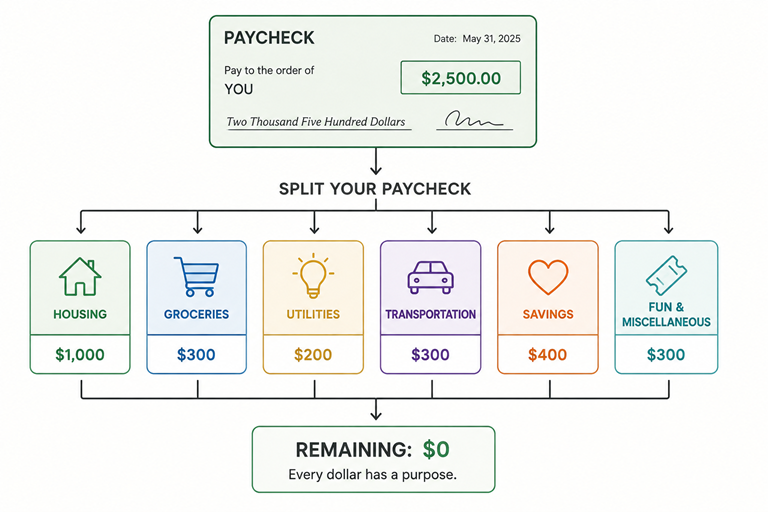
If a full zero-based, category-by-category template feels like too much right now, start simpler. A simple monthly budget template really just needs five sections: your total income from all sources, your fixed expenses as one total or a short list, your variable expenses as one total or a short list, your savings and debt payoff amount, and whatever’s remaining at the bottom.
That structure alone is often enough to get a beginner from “I have no idea where my money goes” to “I actually have a plan,” and you can always add more detail once the basic habit sticks.
If you want a more detailed monthly budget planner, here’s the fuller category list I’d use, which covers pretty much everything most households need to track: housing (rent or mortgage, HOA fees), utilities (electricity, gas, water, internet — and this is exactly where noting “on equal billing” keeps this line predictable), transportation (car payment, insurance, fuel, maintenance), food (groceries and dining out separately), debt payments (credit cards, student loans, personal loans), savings and investing (emergency fund, retirement, specific goals), insurance (health, life, renters or homeowners if not already bundled into housing), personal and discretionary spending (subscriptions, entertainment, clothing, hobbies), and a small miscellaneous or buffer category for the stuff that doesn’t fit anywhere else.
What About a Monthly Budget Calculator?
If you’d rather not build categories from scratch, a monthly budget calculator typically automates a few things for you — comparing your income against your total expenses and flagging whether you’re running a shortfall or a surplus, applying a percentage-based framework like 50/30/20 automatically once you enter your income, and sometimes even projecting savings or debt-payoff timelines, showing roughly when you’ll hit a goal at your current monthly contribution.
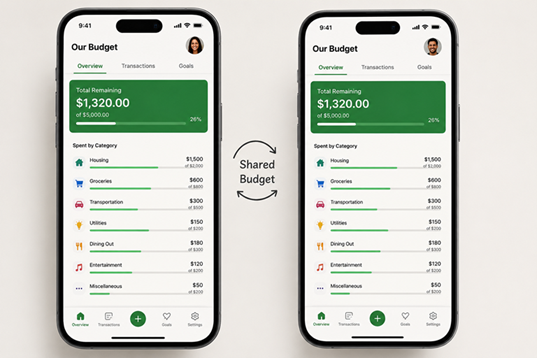
Whether you go with a calculator, a spreadsheet template, or a printable planner really comes down to preference. Spreadsheets give you full control at zero cost but require manual entry. A printable PDF planner works well if you like a physical, handwritten process — it pairs especially well with the envelope method. App-based templates automate the tracking for you, usually at the cost of a subscription. I’ve actually compared several budgeting apps in depth here if you want to go that route: loonnews.com/best-budgeting-apps-for-couples.
Quick Answers to Common Questions
Does equal billing save me money? No — it’s a payment-smoothing tool, not a discount. Your total annual cost stays the same, plus or minus any true-up adjustment; only the timing of your payments changes.
What happens if I use less energy after enrolling? You’ll typically get a credit at your next true-up or reconciliation period, though whether that’s applied to a future bill or refunded outright depends on your provider.
Can I cancel equal billing if I don’t like it? Generally yes, though any accumulated credit or balance owed at the time is usually settled as part of leaving the program — confirm the specifics with your utility company directly.
What’s the easiest way to start a monthly budget if I’ve never done one? Start with the simple five-section template above, track your actual spending for one full month before making major cuts, and then refine into a more detailed method like zero-based or envelope budgeting once the basic habit sticks.
How often should I update my budget? A full review and rebuild at the start of every month, with quick weekly check-ins in between to catch overspending before it snowballs.
Where I’d Start If I Were You
If your utility bills have ever thrown your budget off — and honestly, most people’s have at some point — call your provider this week and ask about budget billing or equal billing under whichever name they use. Then take that newly predictable number and plug it straight into the simple monthly budget template above. It genuinely made building the rest of my budget easier, because one less unpredictable line item is one less thing to guess at every month. Small change, but it made a real difference for me.