Online Teaching Jobs: How to Start Teaching English From Home
My first online lesson lasted eleven minutes before I ran out of things to say. I had a student who genuinely wanted to practice conversational English, a decent internet connection, and absolutely no idea what to actually talk about once “how are you, how was your week” ran dry. I remember staring at the screen thinking, this is not what I signed up for.
It got a lot better after that, and pretty quickly. Once I figured out how to structure a lesson properly and picked the right platforms for where I was starting from, online teaching jobs went from an awkward experiment to a genuinely reliable side income. So if you’re looking into how to teach English online to adults with no degree required, this is the real, practical version of that journey — not the polished sales pitch, the actual process.
You Genuinely Don’t Need a Degree for This
For a long time, teaching English — online or abroad — meant you needed a bachelor’s degree and often an expensive certification before anyone would even consider you. That’s changed a lot, and honestly, it changed faster than I expected once I started looking into it. The explosive demand for conversational English, driven by remote work, international business, and just how connected everything is now, has pushed a lot of platforms to open their doors to non-certified, non-degree tutors specifically.
It helps to understand there are really two different structures you’ll run into. Marketplace platforms, like Preply, italki, and Cambly, work more like matchmaking services — you build your own profile, set your own rates, and put in the effort to build reviews and traction over time. You get total control, but you’re also doing your own marketing. Managed platforms, like Twenix, work differently — they match you automatically with pre-screened students, usually adult corporate professionals, and hand you ready-made lesson materials. You log in, teach, log out, with basically zero planning or marketing overhead. I’d genuinely recommend trying one of each when you’re starting out, since they solve different problems.
Best Platforms for Non-Certified English Tutors
Here’s the part I wish someone had laid out for me clearly when I started — a real comparison of where you can actually get hired without a degree or formal certification, and what to expect from each.
| Platform | Who You’ll Teach | Degree Required? | Certification Needed? | Typical Pay | Best For |
|---|---|---|---|---|---|
| Cambly | Adults, worldwide | No | No | ~$10.20–$12.00/hr (paid per minute) | Instant flexibility, log on whenever |
| Preply | All ages, mostly adults | No | Preferred, not required | $10–$30+/hr, set by you | Scaling income and building a following |
| italki (Community Tutor) | Mostly adults | No | No (recommended later) | $8–$15+/hr to start | High trust, large global student base |
| Twenix | Corporate professionals | No | No, training provided | Fixed mid-range per session | Zero lesson planning required |
| AmazingTalker | All ages | No | Recommended | $10–$30+/hr, set by you | Custom lesson packages, trial monetization |
I started on Cambly specifically because there’s no scheduling required — you just log in when you have time, and if a student is online, you’re teaching within seconds. That instant-access model made it a genuinely useful bridge while I built up reviews elsewhere. If you want to see how this kind of flexible income fits into a bigger savings plan, I’ve written more on maximizing side income here: loonnews.com/how-to-save-money-fast.
What You Can Realistically Expect to Earn
I think it’s worth being honest about the money here, because the range is genuinely wide depending on where you are in the process and which platform you’re using.
On instant-access platforms like Cambly, expect a steady baseline somewhere around $10 to $12 an hour when you’re starting out. Because pay is calculated per minute rather than per booked session, even short 15-minute gaps in your day can technically be monetized, which was honestly one of the more surprising perks once I got used to it.
On marketplace platforms like Preply or italki, new tutors typically start out charging $10 to $15 an hour. That’s not where you stay, though — as you accumulate reviews, somewhere in the range of 50 to 100 five-star reviews, successful independent tutors scale their rates up to $25 to $40 or more per hour. That climb takes real time and consistency, but it’s a genuinely achievable trajectory, not a rare exception.
If you want to push into higher-paying territory faster, there’s a corporate niche worth knowing about. Focusing specifically on Business English, job interview prep, or conversational fluency for tech and finance professionals can get you into the $30 to $60 an hour range, even without a formal degree — as long as your own communication skills and professionalism are genuinely strong. This is where the conversational English tutor side hustle pay ceiling really opens up, and it’s worth aiming for once you’ve got some experience under your belt.
Setting Up Your Home Teaching Studio
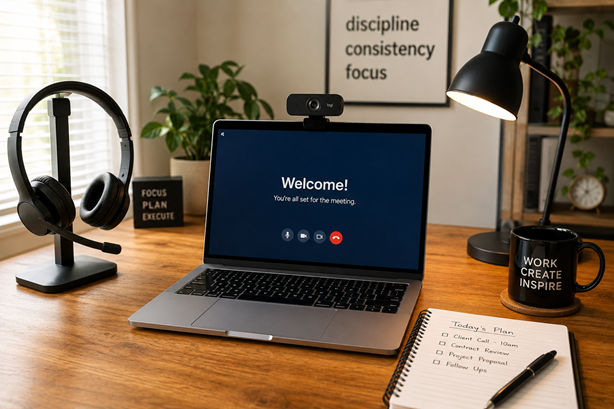
You don’t need a fancy commercial setup for this, but a few pieces of gear made a real, noticeable difference in my student retention once I invested in them.
Start with a reliable computer or laptop — at least 8GB of RAM, enough to handle a browser-based video classroom and an interactive whiteboard running at the same time without lagging. A headset with a noise-canceling microphone matters more than people expect; crisp audio is genuinely more important than sharp video, because students need to hear every vowel and pronunciation nuance clearly, without a hollow room echo distorting things.
An HD webcam positioned at eye level helps a lot too — looking directly into the lens while you talk simulates real eye contact, and it builds rapport faster than you’d think for something so simple. And for your internet connection, hardwire in with an Ethernet cable instead of relying on Wi-Fi if you can. You want a minimum of 15–20 Mbps download and upload speed, because nothing kills a lesson’s momentum like freezing mid-sentence right as a student is finally opening up in conversation.
Your background matters too, more than I expected going in. Keep it clean, well-lit, and free of distractions — a tidy bookshelf, a plant, a neutral wall works well. Avoid flickering lights or high-traffic areas where a pet or family member might wander through mid-lesson. It sounds like a small thing, but it genuinely affects how professional you come across, which affects bookings.
How to Structure an Online English Conversation Class
This is the part that actually solved my eleven-minute-lesson problem, and it’s the single most useful thing I can hand you if you’re wondering how to structure online English conversation classes without a textbook to lean on.
Unstructured chatting sounds easy in theory and falls apart fast in practice — awkward silences kill student retention quickly. What worked for me, and what experienced tutors consistently recommend, is a simple five-part framework for a standard 50-minute session.
Start with a five-minute warm-up using genuinely engaging, low-stakes questions — skip the generic “how are you,” and instead ask something like “what was the best thing that happened to you this week?” or “would you rather live in a city that never sleeps, or a quiet cabin in the woods?” It sounds small, but a good warm-up question sets the entire energy of the lesson.
Next, spend about ten minutes introducing two or three natural idioms, phrasal verbs, or professional expressions tied to the day’s topic — instead of teaching “I am very busy,” teach “I’m swamped” or “I’m snowed under.” Students genuinely light up when they learn phrases that make them sound more natural, not just grammatically correct.
Then move into the core of the lesson — twenty minutes built around a stimulating prompt. A short article snippet, a moral dilemma, a business scenario, a genuinely debatable question like “is remote work making people more isolated or more productive? Defend your view.” This is where the real conversation happens, and where students get the most value.
During all of this, keep a private notepad running for error correction — jot down grammar slips, pronunciation issues, or awkward phrasing without interrupting their flow, then spend about ten minutes near the end sharing those corrections constructively, explaining why a native speaker would phrase something differently rather than just handing them the “right” version.
Close with a five-minute wrap-up — summarize what you covered, genuinely praise their progress, and assign one small task for next time, like “try to use the phrase ‘drop the ball’ in a sentence tomorrow.” That little bit of continuity between sessions makes a noticeable difference in how students engage with the next lesson.
What Experienced Tutors on Reddit and Quora Actually Say Works
A few things I picked up from tutor communities online turned out to matter a lot more than I expected going in.
On platforms like Preply, students often pay for a trial lesson where the platform takes 100% of the commission — which stung the first time I realized it. But experienced tutors consistently reframe this the right way: don’t treat it as free labor, treat it as a high-conversion sales pitch. Find their actual pain point during that trial — something like “I freeze up during English conference calls” — show them a clear roadmap for how you’d help, and close by getting them to book a recurring package. That single mindset shift changed how I approached every trial lesson afterward.
Niching down is another piece of advice that came up constantly, and I think it’s underrated. General conversation tutoring gets crowded fast, with heavy price competition. Community discussions consistently push tutors toward carving out a specific micro-niche — conversational English for software engineers, casual English for travel, pronunciation tuning specifically for Spanish speakers. Once I narrowed my own focus, my bookings actually got more consistent, not less, because students searching for something specific found me faster.
And burnout is real — worth saying plainly. Because independent tutoring has no built-in cap on hours, it’s easy to accept back-to-back classes for six hours straight when you’re excited about the income. Seasoned tutors recommend blocking mandatory ten-minute buffers between sessions specifically to rest your voice, stretch, and log your corrections properly before the next student logs on. I learned this one the hard way after losing my voice halfway through a Thursday.
Your Launch Checklist: Starting This Week
If you’re ready to actually get moving on this, here’s the step-by-step I’d walk through if I were starting over today.
Consider a basic TEFL course first — it’s optional on most platforms, but a low-cost, 120-hour online course over a single weekend gives you real lesson-planning confidence and broadens which platforms you’re eligible for. Organizations like the TEFL Institute offer accessible, well-reviewed options if you want a legitimate starting point.
From there, optimize your tech setup using the checklist above — test your webcam, get a proper headset with a noise-canceling mic, and run a real speed test on your internet connection before your first lesson, not during it.
Record a genuinely strong introduction video, since this functions as your storefront on most platforms. Smile, speak clearly and a touch slower than your natural pace, explain your background honestly, describe how you help students build real conversational confidence, and close with a warm, direct call to action to book a lesson.
Create profiles on two platforms rather than just one — I’d suggest one managed platform like Twenix for immediate, low-effort income, and one independent marketplace like Preply or italki to build your long-term personal brand and set your own rates over time. Diversifying this way protected me when one platform had a slow week.
And finally, build out your lesson templates before you need them — a repository of ten open-ended conversation topics, a vocabulary list, and a handful of debate prompts, so you’re never walking into a session with nothing prepared, the way I was on that very first eleven-minute lesson.
Quick Answers to Common Questions
Can I really teach English online without a degree?
Yes — several major platforms, including Cambly, Preply, and italki’s Community Tutor track, specifically don’t require a degree, and some don’t require formal certification either, though a TEFL course can broaden your eligibility and boost your confidence.
Which platform is best for someone brand new to this?
Cambly is a strong starting point because of its instant-access model — no scheduling required, and you’re paid per minute. Pairing it with a marketplace platform like Preply lets you start building your own long-term brand and rates simultaneously.
How much can I realistically earn as a beginner?
Expect somewhere around $10 to $15 an hour when you’re just starting out, with realistic room to scale toward $25 to $40+ an hour once you’ve built a solid base of five-star reviews, and even higher in specialized niches like business English.
Do I need expensive equipment to get started?
No — a stable laptop, a decent noise-canceling headset, an HD webcam, and a hardwired internet connection cover the essentials. None of it needs to be premium gear; it just needs to be reliable and produce clear audio.
Where to Go From Here
Online teaching jobs genuinely are one of the more accessible side hustles out there right now, especially if you enjoy conversation and don’t mind a bit of a learning curve on the structure side. Start with the platform comparison above, get your basic setup sorted, use the five-part lesson framework so you’re never staring at a screen wondering what to say next, and give yourself real time to build reviews before judging whether it’s working. My first lesson was eleven awkward minutes. A few months in, I had a full recurring student roster and a lesson structure I could run in my sleep. That gap is completely normal — just keep showing up.